Android crushes the competition in China as it passes 90% smartphone market share: Report
 Android has established a clear monopoly in China after achieving
more than 90 percent market share there, up from 58.2 percent a year
ago, according to a new report from Analysys International (via Tech in Asia). The data combines estimates from both devices sales and ownership.
Android has established a clear monopoly in China after achieving
more than 90 percent market share there, up from 58.2 percent a year
ago, according to a new report from Analysys International (via Tech in Asia). The data combines estimates from both devices sales and ownership.Google’s mobile OS soared to 83 percent last quarter, and it has continued its run, capturing an estimated 90.1 percent of the market. It’s possible Android’s overall share is even higher than estimated, as the firm doesn’t count knock-off phones, many of which are powered by the platform.
iOS also dropped from 6 percent to 4.2 percent. However, it may be underrepresented, as Analysys notes that it doesn’t include grey market imports. Since the iPhone 5 is not yet officially available in China, many sellers have resorted to having the device smuggled in from Hong Kong.

Nokia’s Symbian continued its tragic decline, dropping from 6 percent in the second quarter to 2.4 percent in the third. Just a few years ago, Nokia had the dominant position in the Chinese mobile market. With Nokia’s transition to Windows Phone, Symbian is on its way out, but sales of its Lumia devices are still getting off the ground.
Smartphones based on the Windows Mobile, BlackBerry and Linux operating systems took up a negligible share of the market.
Budget smartphones continued to gain momentum, as the average price for Android devices fell yet again, this time to ($223) RMB 1,393 down from $251(RMB 1,560). The average price for a Symbian smartphone came in at $179 (RMB 1,114) and iOS dropped slightly to $726 (RMB 4,523).
With Android taking over almost the whole market in China, at least according to Analysys’ estimates, the country is becoming a stronghold for the platform. Google. however, is unable to properly capitalize on its growing user base there, as many of its services are blocked or constricted.
Local Internet companies have moved in to take advantage of the opportunity. Baidu, for instance, has built its own software that works on top of Android, while Alibaba is pursuing its own mobile operating system that may or may not be based on Android, depending on who you talk to. Chinese smartphone maker Xiaomi has also thrown its lot in with Android for its MIUI ROM and Mi-One and Mi-Two smartphones.
Estimates from Analysys are worth noting because of their consistency, its interpretation of the Chinese smartphone market is just one of many. Recent third-quarter data from app analytics firm Umeng put Apple’s smartphone distribution on its platform at 33 percent.
Google Launches Ingress, a Worldwide Mobile Alternate Reality Game
Liz Gannes

What’s the wackiest thing you can imagine Google launching? How about a game to fight for control of the minds of everyone on earth?
Or maybe that’s not so wacky.
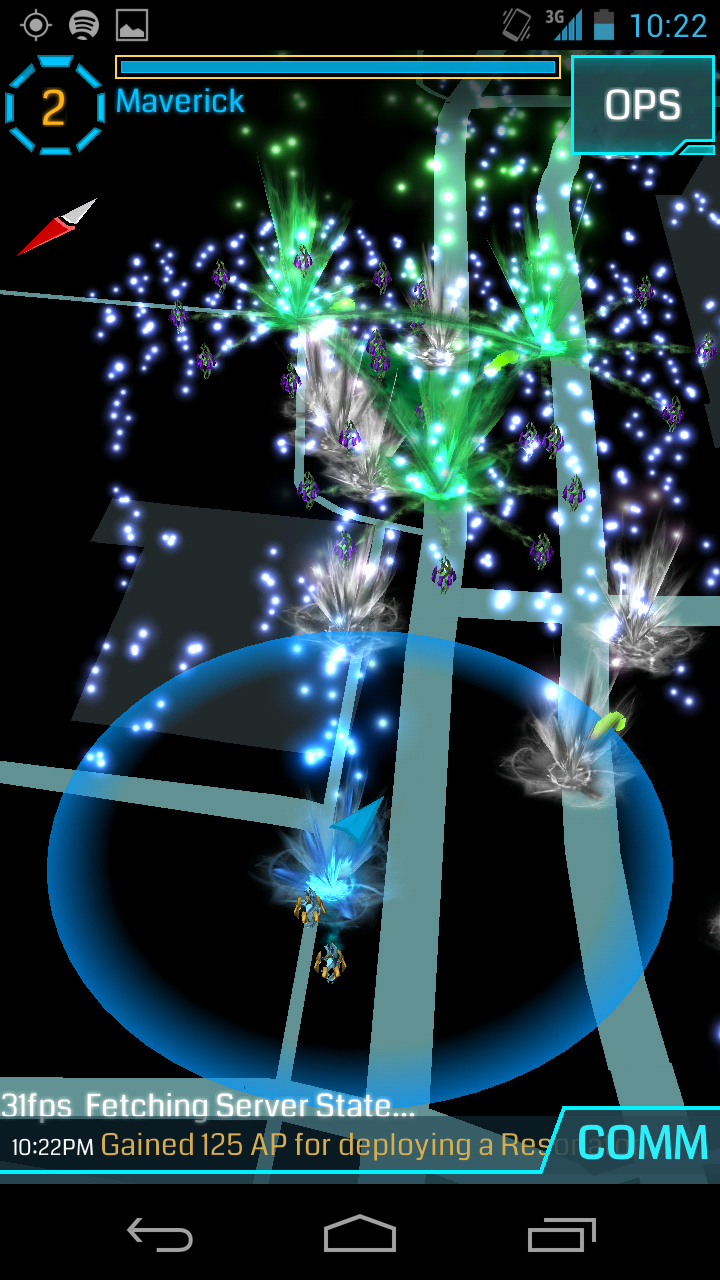
Meet Ingress, a new free mobile app and alternate reality game made by Google launching today (on Android first, available as soon as it makes it through the Google Play release process).
Ingress is a project of former Google director of geo John Hanke and his Niantic Labs, a start-up team wholly inside of Google.
“This grew out of us thinking about notions of ubiquitous computing,” Hanke told AllThingsD this week. “The device melts away.”
 Ingress
also aims to get people out in the physical world, both for physical
activity and to see their surroundings in a new way.
Ingress
also aims to get people out in the physical world, both for physical
activity and to see their surroundings in a new way.Users can generate virtual energy needed to play the game by picking up units of “XM,” which are collected by traveling walking paths, like a real-world version of Pac-Man. Then they spend the energy going on missions around the world to “portals,” which are virtually associated with public art, libraries and other widely accessible places.
“The concept is something like World of Warcraft, where everyone in the world is playing the same game,” Hanke said. Players are on one of two teams: “The Enlightened,” who embrace the power, or “The Resistance,” who fight the power. Anyone can play from anywhere in the world, though in more densely played areas there will be more local competition for resources.
Outdoor physical activity is a big component of this, though driving between locations isn’t banned. “You’re like a rat in a maze on the phone,” Hanke said. Then, back at your computer, you can review the larger area and gameplay.
If self-driving cars or computer glasses are a head-scratching fit for Google, Ingress is perhaps even more so, because it’s a content project that’s expressly askew from reality. The company has hired game writers and artists, and hopes to stay a month or two ahead of the audience, Hanke said.
(You have to admit, this might be pretty fantastic to play from the point of view of those Google glasses.)
 But
Hanke contended that the game will be good for Google’s business from
the beginning. That’s because of advertising. Ingress incorporates real
physical stores and products in the game, and has brokered relationships
with Hint Water, Zipcar, Jamba Juice and Chrome apparel and messenger
bags.
But
Hanke contended that the game will be good for Google’s business from
the beginning. That’s because of advertising. Ingress incorporates real
physical stores and products in the game, and has brokered relationships
with Hint Water, Zipcar, Jamba Juice and Chrome apparel and messenger
bags.And eventually, Google plans to make these real-world game tools available as a platform for developers to make their own.
Hanke said he wants the game to be a living creation that’s shaped by its players. Some early public teasers of the game on a dummy Niantic Project Web site had generated a lot of interest in Russia, Hanke said, so the team wrote some “aspects of Russia” into the game.
Niantic also wants the game to end at some point, or at least have a good stopping point in a year and a half or so.
“We were definitely inspired by JJ Abrams,” Hanke said, “but we don’t want to leave people in a ‘Lost’ situation where they get into the fiction of a world but then it never ends.”
Niantic’s first public product was Field Trip, also a mobile geo app for Android, released in September. Hanke described the factoid-finding Field Trip as “more of a mainstream Web tool” and Ingress as an option for people who are more comfortable with gaming and sci-fi.
The project, which was internally named Nemesis, has been tested by Google employees for the past six months.
Google announces new Shopping experience coming to Europe, Australia, Brazil, and Japan
Google today announced it is bringing its new Google Shopping experience to Australia, Brazil, Germany, France, Italy, Japan, Netherlands, Spain, Switzerland, and the UK. The new version will be rolling out gradually to give merchants some transition time and let them optimize their campaigns.The first major change (cleaner results for shopping queries and Sponsored results) will take place on February 13, 2013. These new queries, which will let shoppers refine a search by brand or price and will feature larger product images, are available on a small percentage of searches starting today. Google is hoping to complete the rollout with all the changes intact by the end of Q2 2013.
If you’re sitting there scratching your head, let me explain. Yes, Google Shopping is available internationally already, but it was a very basic product search service (in fact, it was formerly called Google Product Search). What we’re talking about here is the company’s commercial model, built on Product Listing Ads, which tweaks the ranking in Google Shopping to be based on a combination of relevance and bid price, as well as throws in a few actually useful features.
Back in May, Google announced a new service that lets shoppers research products better, compare them based on features and prices, and connect with merchants to make their purchase. In other words, what a shopping service should do in the first place. This new model fully launched in the US on October 17, and now the company is pushing it out to the rest of the world.
Why did Google make the change? Here’s what the company says:
We made this transition because we believe that having a commercial relationship with merchants will lead to better, more up to date product data — which will mean better shopping results for users and in turn, higher quality traffic for merchants. We think this will bring the same high-quality shopping experience to people — and positive results to merchants – around the world.In other words, Google Product Search sucked and the company was getting trampled by the competition (not to mention the lawsuits). Now Google claims to have come up with something that benefits both shoppers (products in one convenient place where they can compare and check out reviews) and merchants (advertisers get more granular control over product listings and traffic). Oh, and Google gets to make more money, of course.


